Earning the OSWA: WEB-200 and the Playbook That Got Me There
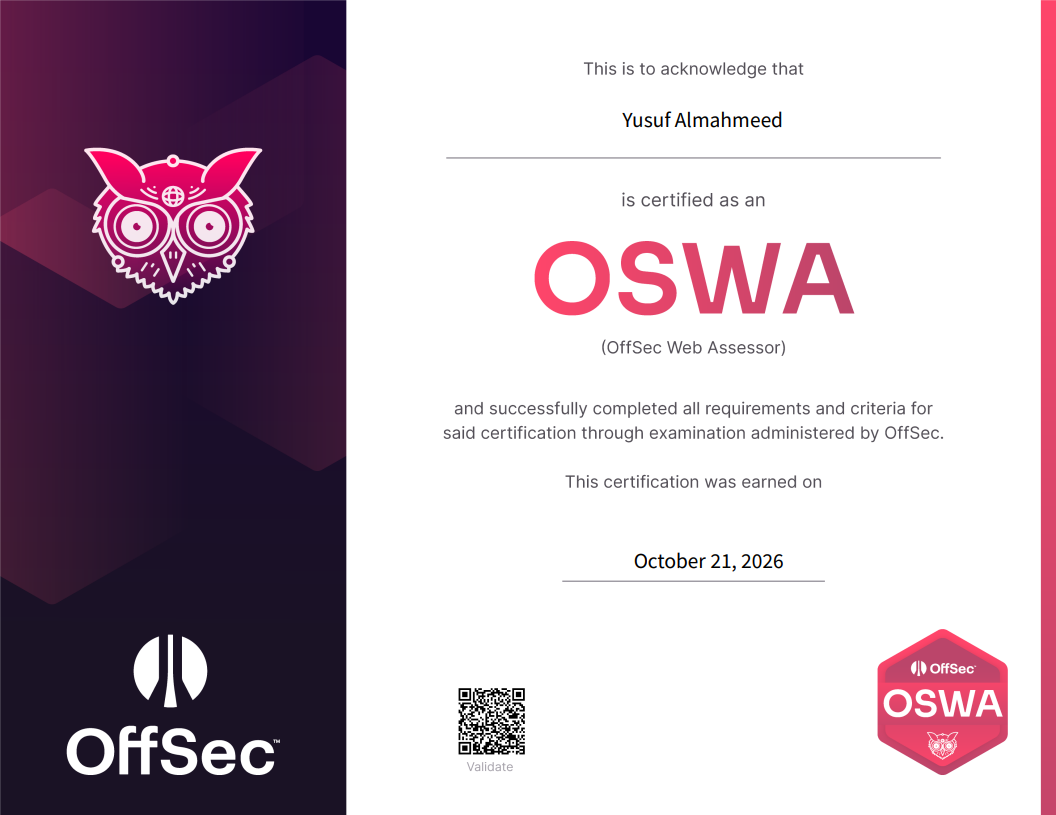
Table of Contents
The OSWA (OffSec Web Assessor), earned through OffSec’s WEB-200 course, is a certification for black-box web application security assessment. It’s a hands-on, practical exam, not a multiple-choice test: you’re put in front of vulnerable web applications with little more than a URL and asked to find and exploit real vulnerabilities, then write them up the way you would for a client.
I wanted to write this up because the certificate itself is the least interesting part. The valuable thing OSWA gave me was a system, a repeatable way to approach any unfamiliar web app, and that’s what I want to share here: what the cert validates, how I prepared, and the methodology and mindset that worked for me. Everything below is general web-assessment knowledge and my own study approach, not exam content.
What the OSWA validates#
The cert isn’t really about any single exploit. It’s about the black-box workflow: take an app you’ve never seen, map it, reason about where each feature could break, test systematically, prove the issue, and report it clearly. Reporting is half the point: a finding you can’t document reproducibly isn’t much use to anyone.
One detail from the public exam guide that shapes the whole approach: for OSWA, proof through the web UI is valid; a shell is not required. If you can read the target’s data through XXE, SQL injection, directory traversal or IDOR, that is the finding. This is a real contrast with the shell-focused OffSec certs, and it keeps the focus where it belongs for a web assessor — on the web vulnerability itself.
What it covers#
WEB-200 is organized around the vulnerability classes you actually meet in web assessments. My own notes ended up mirroring that structure, a page per class. The headline topics:
- SQL injection
- Cross-site scripting (XSS)
- XML external entities (XXE)
- Server-side template injection (SSTI)
- OS command injection
- Directory traversal
- File upload flaws
- IDOR and broken access control
- Server-side request forgery (SSRF)
- CORS and CSRF
- Authentication attacks (login brute force, username enumeration, type juggling)
Plus the connective tissue that ties them together: enumeration and recon, Burp Suite fluency, and, where a foothold naturally leads there, a little post-exploitation. No single bug in that list is exotic, and that’s the point; the skill is stringing enumeration → reasoning → exploitation → evidence into a reliable loop you can run against anything.
What the exam itself is like#
It’s entirely practical. OffSec gives you access to a private, isolated network containing five separate target web applications, each deliberately built with real security weaknesses. Your job is to break into each one the way an attacker would, and to prove you did. The proof takes the form of small secret files called flags: each target holds two of them, one for getting an initial foothold and a second for deeper access. Every flag is worth 10 points, for a maximum of 100, and you need 70 to pass; the full format and scoring are set out in the official OSWA exam guide .
The time budget is generous but intense: a single sitting of 23 hours and 45 minutes of hands-on exam, done under live proctoring, with a proctor monitoring your session throughout to keep the exam fair. Per OffSec’s AI usage policy , AI chatbots and LLMs aren’t permitted, even though your own notes and the internet are. When the hands-on window closes, a separate 24-hour clock starts for the part people underestimate: the report.
That report is the real deliverable. Finding the bugs isn’t enough: you have to hand in a professional penetration-test report that documents each finding clearly enough for someone else to reproduce your exact steps. A disorganized write-up can cost you points even when the hacking was sound, which is why so much of my preparation went into documentation habits, not just exploitation. Results typically arrive by email within about ten business days.
How I prepared#
Three things did the heavy lifting: a notes system, a methodology, and a lot of hands-on repetition.
A notes system I’d actually use under pressure. I built a reference organized by vulnerability class, one page each for SQLi, XSS, XXE, SSTI, command injection and the rest, with the commands and payloads in collapsible toggles so I could expand only what I needed. The goal was muscle memory, not a wall of text. Mid-assessment I want the next move, not a reference manual.
A methodology, written as a checklist. On top of the per-class notes I kept a single procedural page, the “what order do I do things in” list: configure Burp and scope before touching anything, scan and fingerprint the stack, enumerate content with more than one wordlist, crawl the app manually to understand its user flows, then test every input as I map it rather than saving testing for a second pass. Once I have any access, re-enumerate from that privilege level, because new endpoints and weaker filters tend to appear.
The piece I leaned on most was a pattern-recognition checklist I think of as my Assumptions list: feature → assumption → technique. For example, a contact form assumes reflected or stored input, so it gets tested for XSS and SQLi. Turning “what is this feature?” into “what does this feature let me assume, and what do I test for it?” is most of the game, and it’s what stops you skipping something because you didn’t have a hunch about it.
Custom tooling. I wrote Cataract (on GitHub ), a small Bash tool that cascades escalating wordlist tiers through feroxbuster while an nmap scan runs in the background, so the slow part of recon runs itself while I start reading the application.
Reps, reps, reps. Theory only sticks when you break things. I drilled each class on PortSwigger’s Web Security Academy and wrote up what I learned, which is where a lot of this blog comes from, the SSTI series , the XXE series and the OS command injection series . I also built and attacked small local vulnerable apps and worked general practice machines to keep the enumeration-to-exploit loop sharp. Writing each one up was deliberate: if I couldn’t explain a bug clearly, I didn’t really understand it, and explaining clearly is exactly what a report asks for.
The mindset that worked#
A handful of habits mattered more than any individual payload:
- Enumeration first, always. Most of the work is understanding the app before attacking it. Map the attack surface and note every input before deciding what to test.
- Test as you map. Reflected-input and injection probes go in while I’m still clicking through the app, not in a separate later pass.
- Think in assumptions, not exploits. Letting each feature trigger a fixed set of tests keeps coverage systematic, so nothing gets skipped for lack of a hunch.
- Re-test at every privilege level. Filters and access controls often differ per role, so a class that was “safe” unauthenticated may not be once you’re logged in.
- Evidence discipline. Screenshot every finding the moment you confirm it and draft the write-up right away. Secure your proof as soon as it’s visible; don’t go chasing a shinier exploit and lose the one you already had. Because web-UI proof is valid for OSWA, a clean request/response plus a screenshot is often the whole finding.
- Reporting is a skill, so practice it. A clear, reproducible report is the deliverable, so treat the writing as part of the work, not an afterthought.
Advice if you’re heading for the OSWA#
- Build your own notes, organized by vulnerability class, with commands in toggles you can expand on demand. Notes you wrote yourself are the ones you’ll trust under time pressure.
- Do PortSwigger end to end, and write up what you learn. Teaching something is the fastest way to find the gaps in your own understanding.
- Make your methodology a checklist, not a vibe, and pair it with an assumptions list so every feature maps to a concrete set of tests.
- Practice the report, not just the hacking. Draft findings as you confirm them; a finding you can’t reproduce on paper isn’t finished.
- Get fast at enumeration and automate the boring parts. That’s exactly why I wrote Cataract.
- Manage your time and secure proof early. Capture evidence the moment a finding lands, then decide whether going further is worth it.
Resources#
- OffSec WEB-200 course — the official course behind the OSWA.
- OSWA exam guide — official structure, scoring, and rules.
- PortSwigger Web Security Academy — free, hands-on labs for every web-vulnerability class.
- My write-ups drilling those classes: the SSTI series , the XXE series , and the OS command injection series .
- Cataract — my tiered web-enumeration tool (source ).
Closing#
What I value most from OSWA isn’t the four letters; it’s that it pushed me to turn scattered web-security knowledge into something repeatable: a methodology I follow, a notes base I trust, and tooling I built and understand. That system outlasts any one exam.
Next for me is more of the same: deeper web research, more labs and tooling, and in time the heavier exploit-development side of web security. If you’re considering the OSWA, it’s a worthwhile path for anyone who wants to assess web applications properly rather than just run a scanner over them.
As always: only ever against systems you’re authorized to test.