Certified Cloud Penetration Tester: Attacking and Defending Azure, AWS & GCP at DEF CON Training Middle East
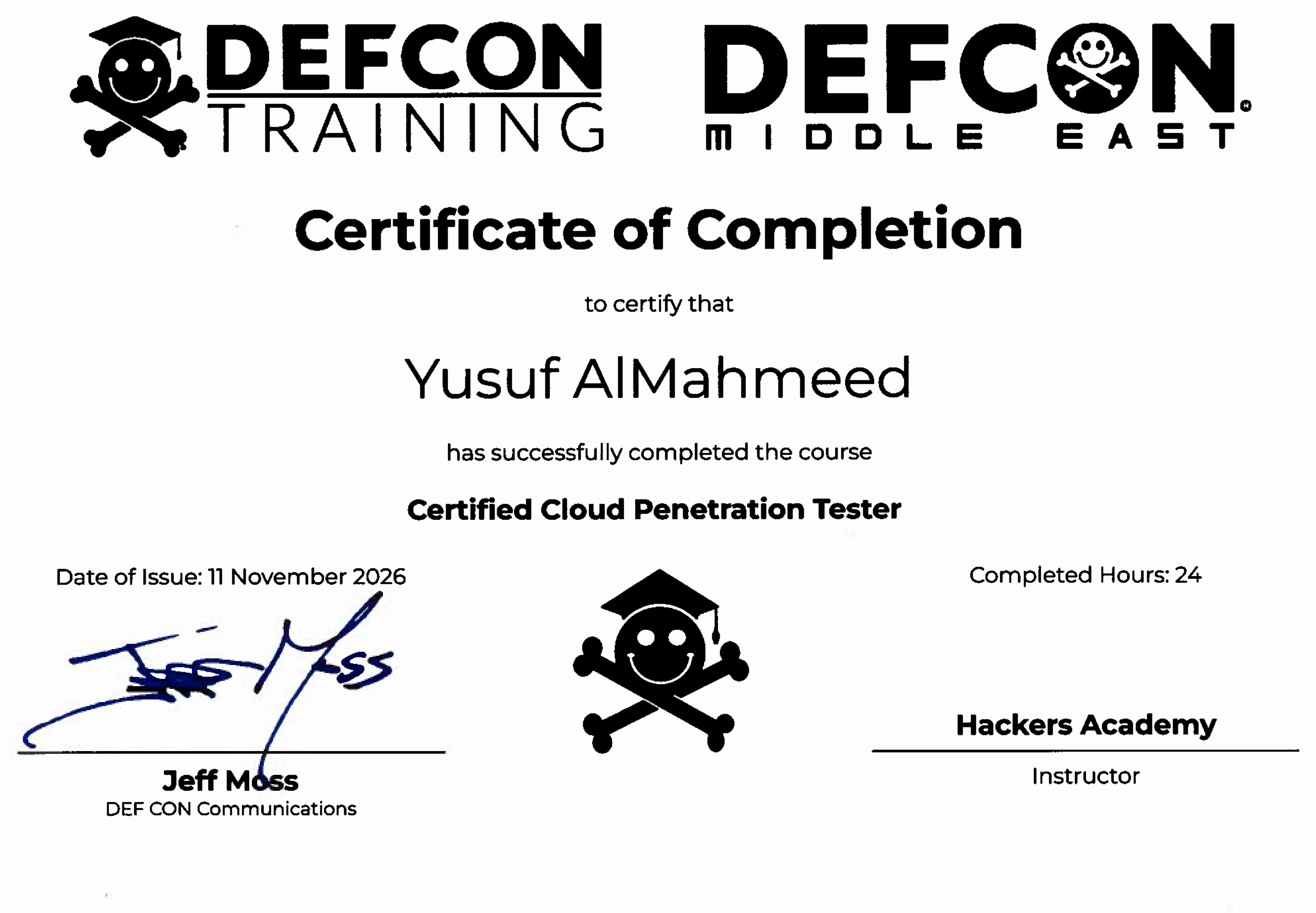
Table of Contents
| Certificate | Certified Cloud Penetration Tester |
| Issuer | Hackers Academy |
| Issued | 11 November 2026 |
| Event | DEF CON Training Middle East 2026 · Bahrain |
My hands-on security background runs from on-prem infrastructure to web application testing, and cloud is where I wanted to extend it next, since that’s increasingly where the workloads, and the risk, live. Modern breaches play out in cloud tenants, and the entry point is rarely a dramatic software exploit; it’s a leaked key, a public bucket, or an over-permissive role. To go deep on that shift from the attacker’s side, I attended DEF CON Training Middle East 2026 , and took the Certified Cloud Penetration Tester course.
About the course#
The course was delivered by Hackers Academy over three days. It was heavily hands-on: more than twenty cloud-based labs against a realistic target environment. The structure stayed consistent throughout: look at each service the way an attacker would, then turn straight around to the control that shuts the attack down.
What it covered#
The course worked through the three major cloud providers, each from first-contact recon to persistence.
Azure. Tenants and Entra ID, recon and enumeration, initial access (password spraying and device-code phishing), the gaps that open up around Conditional Access and MFA, storage, virtual machines and managed identities, and Key Vault.
AWS. IAM users, roles and policies, S3, the impact of leaked access keys, post-access enumeration, EC2 instance metadata (IMDSv1 versus IMDSv2), Lambda misconfigurations, and the privilege-escalation and persistence paths that follow.
GCP. The resource hierarchy and how IAM permissions inherit through it, service accounts and their keys, Cloud Storage, Compute Engine metadata, Secret Manager, impersonation-based privilege escalation, persistence, and BigQuery.
Different consoles and different names, but the same lesson under all three: cloud compromise comes overwhelmingly from misconfigurations and identity weaknesses, not from CVEs.
The CTF#
The course finished with a capture-the-flag exercise: a simulated multi-cloud assessment spanning AWS, Azure and GCP, starting from a single leaked access key. The challenge was to see how far that one foothold could reach, and it reached all three clouds. I captured every objective and finished first in the CTF.
What stayed with me wasn’t the flags but the shape of it: the whole thing came down to identity and misconfiguration, not a single software exploit. One misplaced secret, or one security control left switched off, was enough to open the next door. It was a clean demonstration of the course’s core lesson: in the cloud, identity is the perimeter.
My key takeaways#
Identity is the new perimeter. In the cloud the prize isn’t a server; it’s a role or a service account. Once an attacker controls an identity, the permissions attached to it decide how far they get, which is why least privilege matters more than any single patch.
The same attack paths repeat across every cloud. Obtain keys, public storage, the instance metadata service, and over-permissive IAM show up in Azure, AWS and GCP alike. Learn the pattern once and you recognize it everywhere.
Closing#
My thanks to the National Cyber Security Center of Bahrain and DEF CON Training, and to Hackers Academy for a dense, practical three days.